

I’m grateful to share a new article: “Do We Really Understand Microaggressions?” which is published online with Ms. Magazine. This piece is co-authored with Rasha Diab and part of our ongoing research on countering microaggressions. Here’s the opening: In recent years and especially since summer 2020, in the aftermath and reckoning of George Floyd’s murder, the term “microaggression” has become commonplace. Every week, new stories highlight racial microaggressions in ... Read more ...
epistemic injustice
Countering Imposter Syndrome: Workshop Handouts and Resources

Welcome to this page of handouts and resources for the upcoming presentation “Countering Imposter Syndrome and Affirming the Right to Belong.” Designed for students and faculty, this presentation is sponsored by the Doctor of Education (EdD) in Educational Leadership at the University of Louisiana at Lafayette. The event will be held remotely via Zoom on Tuesday, May 4th 6:00-7:30pm Central time. Workshop Description How can we (researchers, mentors, advisors, ... Read more ...
Q&A with Rasha Diab: Pursuing Peace as Everyday Practice

Since starting this series of interviews, I’ve wanted to highlight Rasha Diab, because she’s one of the most important people in my life. More than a co-author and friend, Rasha is truly an accountability partner: the first person I turn to process experiences, to understand emotions, to grow into new understandings, to repair harm I’ve done, and much more, including to laugh and cry and rage. Rasha has a way of holding potential—visualizing the best self—while staying ... Read more ...
Career Discernment for Academics: An Interview with Self-Compassionate Professor

I’m grateful to Danielle De La Mare of the Self-Compassionate Professor for inviting me to do an interview that’s become “Episode 19: Career Discernment with Dr. Beth Godbee.” This interview relates both my career discernment story and how I understand career discernment as a lifelong, ongoing process of finding and following the “strong yes.” Here’s what Danielle says about the interview: “Former professor, Dr. Beth Godbee, joins me for the first episode of Season 2! ... Read more ...
When Speaking Up at the Holidays Means “Complaining” and Being the Killjoy

Last year, during the holidays, I blew up (yelling, cursing, and storming off), and the experience highlighted for me the need to embrace criticisms that I’m “too sensitive,” “too critical,” and “too complaining.” On the day I blew up, I was so overwhelmed, disconnected, and worn down by systemic oppression that my body couldn’t take it. I held myself together until I couldn’t hold it in anymore: then, I released a tidal wave of rage. I’m still processing, but I’m ... Read more ...
Why I Don’t Believe the #CovingtonCatholic Student’s Statement

I woke up today (the day after MLK Day in the U.S.) to a Facebook friend who presents as a white woman asking if I’d seen the #CovingtonCatholic student’s statement because she’s not sure what to believe. Later in the day, a white family member also sent me the statement, presumably to vindicate the white students. These messages come in response to me speaking out over the past few days about the incident, asking for white folks to break patterns of niceness and to ... Read more ...
Against the Tyranny of Positivity

On this day of the lunar eclipse in Aquarius, may we allow ourselves to feel. To feel whatever comes up. To feel deeply, expansively, expressively. To feel a fuller range of emotions than we’re typically taught is appropriate or agreeable or allowable to feel. To grieve for Nia Wilson, for Markeis McGlockton, and for many people whose lives are deemed expendable. To rage against white supremacy, patriarchy, colonization, and oppression. To push past easy, ready, ... Read more ...
Naming Trauma as Trauma
As part of my research on epistemic injustice, I’ve been thinking about the power of naming: the power of having the linguistic resources to identify, describe, and call out varied experiences, especially experiences of injustice. Systemic oppression works in a way that denies the ability to name experiences of wrongdoing. When experiences are named, they can be acknowledged and addressed. To me, this is part of the power of the word microaggressions: the word allows ... Read more ...
A Barrage of Microaggressions
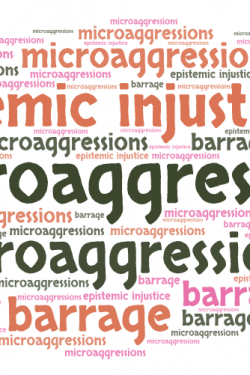
Some years ago I began recording everyday microaggressions toward learning to recognize racism, which is so often coded and which whiteness has taught me not to see. This recording project aimed at building a repository of common microaggressions to teach with and practice interventions using Augusto Boal’s theatre of the oppressed. The project emerged from conversations with colleagues of color, who shared how often white colleagues failed to believe their experiences. ... Read more ...
Expect Miracles

Of the many lessons I’m still learning, an important one is to trust life as it unfolds. I struggle with trust because I struggle with letting go of perfectionism and perceived control. Despite these struggles, whenever I soften attachments to my preferred timing and open instead to possibilities, miracles occur. And the more I open to miracles, the more I find HOPE, which is so greatly needed on the long haul toward justice. Recently, I’ve had an important reminder ... Read more ...

