

What’s demanded of us for living relationally and responsibly in the midst of a global pandemic? What’s demanded in this time of uncertainty, chaos, and crisis—a time that’s highlighting how precarious everyday life is, especially for people meant not to thrive within oppression? Sitting with these questions, here are three scenes. May weaving together story threads help with realizing—and perhaps reaching toward—collective responsibilities. Scene 1: Processing with ... Read more ...
learning
Words Cast Spells: Spell-Casting for 2020 to Experience Grief, Temperance, and Abundance

Though the new year marks a time for review and renewal, it’s often a few weeks into the year before I’m ready to set new goals via the contemplative practice of spell-casting. It’s as though I have to get out of the turbulent holiday season and new year energy before I’m ready to engage the magic of habit formation. This year (like the past couple) I’m returning to the practice of writing spells (like mantras, poems, or intentions) that I’ve learned through adrienne ... Read more ...
Eating for Justice? Why Explore Relationships with Food

Relationships with food are tricky at all times of year, but this is especially the case in January. From the pressures of new year resolutions to weight-loss goals and fitness challenges, January highlights the swing from decadent December eating to body-shaming that’s associated with “getting in shape.” Or, in the words of a recent article by Zoe Fenson: “January is the month of body shaming. I’m tuning out.” In recent years, January has also been fashioned as ... Read more ...
When Speaking Up at the Holidays Means “Complaining” and Being the Killjoy
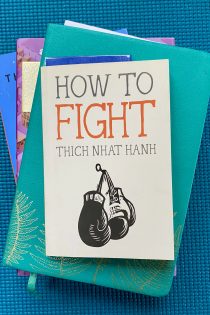
Last year, during the holidays, I blew up (yelling, cursing, and storming off), and the experience highlighted for me the need to embrace criticisms that I’m “too sensitive,” “too critical,” and “too complaining.” On the day I blew up, I was so overwhelmed, disconnected, and worn down by systemic oppression that my body couldn’t take it. I held myself together until I couldn’t hold it in anymore: then, I released a tidal wave of rage. I’m still processing, but I’m ... Read more ...
3 Reasons to Participate in the 40-Day Practice on Strengthening Emotional Literacies to Counter White Fragility
Starting on November 22nd and running for the final 40 days of 2019, I’m offering the “40-Day Practice: Strengthening Emotional Literacies to Counter White Fragility.” Every time I offer this practice (this will be my third and second online), I get a lot of questions, including what this work involves, why it asks for a commitment of 40 days, and why it focuses on emotions. Though I hope the course description answers many of these questions—and I’m happy to answer ... Read more ...
Q&A with Alexa Eason: Intern with Heart Head Hands

This post introduces Alexa Eason, Georgetown senior and intern with Heart Head Hands, as she talks about her internship projects, semester goals, and commitments. This post also introduces a new series of interviews aimed at sharing projects related to social, racial, and environmental justice *and* asking others the question that runs through this blog: “How do you strive toward everyday living for justice?” In future Q&A posts, we’ll learn about embodied healing ... Read more ...
From Fear to Love: Working with Emotional Overload

Emotional Overload Is Rooted in Fear Last week I said goodbye to the phone I’d had for more than 3 years, a phone I was attached to more than I’d like to admit. I entered a state of complete overwhelm, spiraling between questions and frustrations, between crying and raging: How could I possibly learn a new phone? Why aren’t there any small phones? How will one of the new—BIG—phones fit in my pocket? It’s not fair that all the phones are large, while women’s pants ... Read more ...
Responding to Microaggressions

How do we respond to microaggressions, or those everyday and commonplace actions that convey bias, invalidate people, and reinforce structural oppression? We know from research and personal accounts that microaggressions occur all-too-frequently across contexts—workplaces, family gatherings, and community settings. From hurtful words to dismissive gestures, microaggressions do more than communicate harm. They have wide-reaching impact, for they deny access, constrain ... Read more ...
Self-Inquiry and Social Justice: What’s Walking Got to Do with It?

This summer I’m offering “40 Questions for 40 Walks: Toward Everyday Living for Justice”—a self-paced e-course to support deep-diving into conditioned ways of living, being, and intervening in the world. My hope is that these 40 questions provide structure and invite attention to a wide range of matters that factor into everyday life, yet may be easily taken-for-granted or overlooked as important to social justice, racial justice, and environmental justice. Why ... Read more ...
How Small and Sustained Actions Turn Resolutions into Habits

Typically, by mid-year (by the summer solstice for those of us in the northern hemisphere), new year’s resolutions are a thing of the past. Months after setting resolutions, it’s easy to have forgotten or moved through them—with seasons shifting our embodied needs, creating the conditions for new intentions to be named. The summer solstice, then, provides the occasion for setting new resolutions, for looking backward to previous ones and forward to daily practices that ... Read more ...

