
In this Q&A post, we learn from Traci Higgins, a governing board member of Kindred since 2017 and director of human resources of the Legal Services Corporation since 2012.
Alexa Eason, intern with Heart-Head-Hands in fall 2019, initiated this interview with Traci, recognizing her years of work toward social and racial justice. Alexa and Traci met through the Georgetown Scholars Program: Alexa as a current scholar, Traci as a mentor. As Alexa says:
On paper Traci is my mentor, but she has become someone I consider to be family. She is a radiant beam of light to me and others. Her drive to do for others is what inspires me. Ultimately, I am so grateful for her and the impact she continues to make in my life.”
In what follows, Traci discusses how she strives to be of service in the world—through work, mentoring, and community leadership. We hope you’ll read this piece to learn more about Traci’s work in DC and especially with Kindred, which facilitates parent-driven equity and diversity in schools. If you are moved by what you read, you can give to Kindred here.
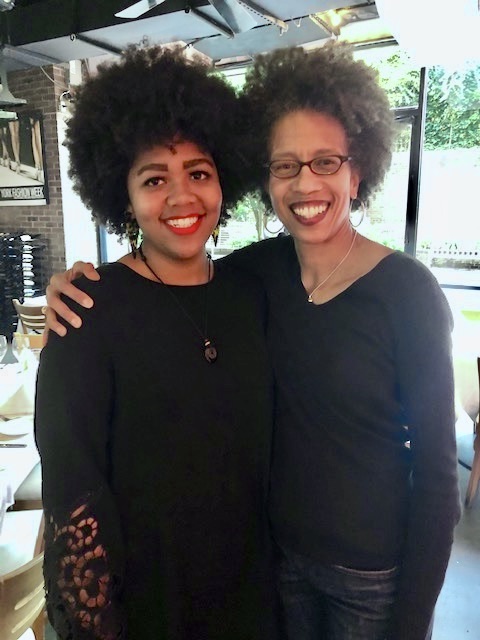
Photo shows Alexa Eason (left) and Traci Higgins (right).
1. Tell us about yourself.
I am the daughter of Irene Louise Hunter Higgins, which means I was raised to do for others. Whether it was going door-to-door collecting donations for the American Lung Association, canvassing for candidates running for political offices, or shoveling the common walkway after a storm, I learned that you do what you can to advance worthy causes, and that you do so willingly and often without being asked. Despite coming from humble beginnings, I have learned well that of those to whom much is given, much is required.
It also is significant that I am a Georgetown University graduate. Georgetown lives and daily affirms its commitment to social justice and reminds us always that we are “women and men for others.” Service is at the heart of the university, and it informs who I am and how I walk in the world.
2. How did you get involved in Kindred, and how does the organization work to counter educational inequities?
After the 2016 elections, I was angry. I knew I had to work against the ugly unleashed on our country but didn’t know what form that would take. So I sat quietly, waited. And then waited some more. I was introduced to Kindred (www.kindredcommunities.org) in October of 2017 and immediately accepted the invitation to join the board.
Kindred is committed to equity and diversity and works with parents and school leadership to ensure that these ideals are realized in our schools. Kindred works to build trusting relationships between diverse groups of parents by facilitating structured dialogues in which parents explore their backgrounds, race and equity, and goals for their children. By working together, they build community across differences in the service of ensuring equity and diversity in our schools.
Because the squeaky wheel gets the grease, with the quickly changing demographics of many of DC’s public schools, it is important to harness the collective energy of all parents to ensure great outcomes for ALL students, not just those whose parents have out-sized influence. When decisions are made to ensure the equitable distribution of school resources, all students win. And it’s working. Our parents are working collaboratively with school administrators and are changing school dynamics and the way decisions are made.
3. How does a commitment to social justice factor into your work in human resources?
At its core, social justice is about fairness, about equal treatment, about decency, and about respect. To create a great place to work, you have to build and foster a culture actively committed to honoring and making real those same values. Everyone wants a fair shake, to know that the playing field is level, that their voice will be heard, honored, and respected. Playing by the rules—and having the right rules—matters.
When I worked in labor relations for DC Public Schools, I earned a reputation among the union leaders of being “tough, but fair.” That meant a lot to me. Sometimes I had to make difficult calls, but I made them based on the facts and the rules, not on my personal views or with animus. I didn’t have to like everyone, but I always had to treat them fairly.
4. How did you decide to get involved in the Georgetown Scholars Program, and how does your own experience (as a student and now as a professional) influence the work you do with mentoring?
The second I heard about the Georgetown Scholars Program (GSP), I knew I had to be involved. GSP recognizes that it isn’t enough to get first-generation and low-income students to college; we also have to get them through college and to success beyond.
Navigating college as the first in your family can be daunting. Without the benefit of parents and guardians who have attended, students are left to their own devices to unlock what my colleagues at Georgetown aptly call “the hidden curriculum.” GSP provides amazing support to our students to ensure they have the skills, tools, and knowledge they need to successfully take on their college experience.
As a first-generation student many years ago (although we didn’t use that term then), I was able to cobble together the different supports Georgetown offered to make my way. Now Georgetown is very intentional and comprehensive in the approach it takes to supporting these populations, and it makes all the difference in the world. GSPers are thriving and actually boast a higher graduation rate than the general Georgetown population.
In serving this program, both as a mentor and Advisory Board member, I am able to draw on my experiences to relate to and connect with students. As an African American woman who grew up in a housing project, I look like many of the students and understand the challenges they face as they move beyond the circumstances of their upbringing while staying connected to their families and the daily struggles that remain real for them. They are navigating different worlds simultaneously.
In my board role, I’m able to help some of my fellow board members who don’t have first-hand knowledge of the realities of poverty and discrimination bridge gaps in their understanding and gain deeper insight into the lives of our students. Providing opportunities is crucial, and it’s equally important to provide a playbook on how to fully access and take full advantage of those opportunities.
5. How do you strive toward “everyday living for justice”?
By maintaining a service orientation in all that I do, doing right by others and for others is central to who I am and lives and breathes in me every day. When I encounter a situation where I can help, I do. I have a voice and, in some circumstances, power and authority. I choose to use those to help others.
For example, I have become friends with an extended family from El Salvador and through simple interventions—writing a letter, placing a phone call, attending a meeting—I have been able to keep members from being fired, from being forced to pay thousands of dollars they didn’t owe, from being denied a driver’s license renewal because of inaccurate records. Although I don’t practice law these days, using my voice as a lawyer matters. And it underscores the vital importance of access to legal assistance to address the myriad issues that challenge low-income people.
Access to lawyers means access to justice. I don’t have to initiate a lawsuit to find justice for people. I have to speak up and act. That’s required of me. Of each of us. Every day. All day.
—
This interview is conducted by Beth Godbee and Alexa Eason with Traci Higgins for Heart-Head-Hands.com. Traci’s post is the third in the new interview series.
In addition to supporting Kindred, you can support the work of Heart-Head-Hands: Everyday Living for Justice through Patreon, where you’ll find additional monthly content.
Also, consider subscribing to the newsletter and liking this blog on FB. Thanks!


Leave a Reply