

Recently, a Patreon subscriber shared that they appreciate reflection questions, and their feedback prompted me to consider which questions feel especially important for this summer (summer 2021). Spinning off the original Q&A response (shared as part of the Q&A newsletter for subscribers), here are some questions I’m sitting with. These are influenced by the CHANI app (“astrology for self-discovery, mindfulness, and healing” by Chani Nicholas and team). The app ... Read more ...
reading
Countering Imposter Syndrome: Workshop Handouts and Resources

Welcome to this page of handouts and resources for the upcoming presentation “Countering Imposter Syndrome and Affirming the Right to Belong.” Designed for students and faculty, this presentation is sponsored by the Doctor of Education (EdD) in Educational Leadership at the University of Louisiana at Lafayette. The event will be held remotely via Zoom on Tuesday, May 4th 6:00-7:30pm Central time. Workshop Description How can we (researchers, mentors, advisors, ... Read more ...
Reflections on Silence, Fear, Courage, and Writing: Always Come Back to Writing

This past month I’ve read Audre Lorde’s The Cancer Journals: one of the books I’ve heard and thought and talked about long enough that I’ve felt a knowing of it, yet never read it. And the timing of reading it now—during a global pandemic, in the midst of winter, and at a time when I’m trying to figure out my relationship with worsening asthma—has felt miraculously timed. It’s felt particularly significant to read Lorde’s oft-cited quote “your silence will not protect ... Read more ...
Q&A with Cedric Burrows about His New Book Rhetorical Crossover: The Black Presence in White Culture

This Q&A blog post features Cedric D. Burrows, Ph.D., an assistant professor of English at Marquette University and author of the new book, Rhetorical Crossover: The Black Presence in White Culture (University of Pittsburgh Press, 2020). Cedric’s scholarship focuses on African American rhetoric, cultural rhetorics, social activism, and the legacies and contributions of Dr. Martin Luther King, Jr., Malcolm X, and the Civil Rights Movement. As a colleague of Cedric’s, ... Read more ...
Q&A with Tamika Carey: “Gestures Are Easy. Reckoning Is Hard.” On Prioritizing Wellness and Liberation

I’m particularly excited about this Q&A blog post with Tamika Carey, Ph.D., an interdisciplinary scholar whose work is not only shaping the fields of cultural rhetorics, African American rhetorics, and feminist rhetorics but also deeply impactful for literacy studies, cultural studies, and women’s and gender studies. Tamika Carey is an Associate Professor of English at the University of Virginia, an award-winning author, and a committed educator. I came to know ... Read more ...
Q&A with Rasha Diab: Pursuing Peace as Everyday Practice

Since starting this series of interviews, I’ve wanted to highlight Rasha Diab, because she’s one of the most important people in my life. More than a co-author and friend, Rasha is truly an accountability partner: the first person I turn to process experiences, to understand emotions, to grow into new understandings, to repair harm I’ve done, and much more, including to laugh and cry and rage. Rasha has a way of holding potential—visualizing the best self—while staying ... Read more ...
Eating for Justice? Why Explore Relationships with Food

Relationships with food are tricky at all times of year, but this is especially the case in January. From the pressures of new year resolutions to weight-loss goals and fitness challenges, January highlights the swing from decadent December eating to body-shaming that’s associated with “getting in shape.” Or, in the words of a recent article by Zoe Fenson: “January is the month of body shaming. I’m tuning out.” In recent years, January has also been fashioned as ... Read more ...
Responding to Injustice: Why Settling the Nervous System and Slowing Response Times Matter
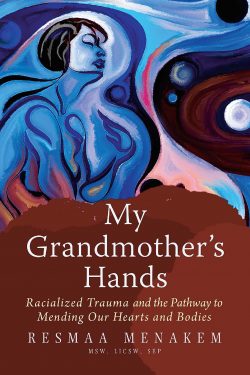
Recently, I’ve had several moments of witnessing first-hand the links between settling the body (that is, settling the nervous system) and showing up more mindfully, more open, and more like the “best self” that’s needed when striving for social and racial justice. In contrast, moments when my nervous system is “keyed up” (from exhaustion, from unresolved tension, from disappointment, and more), I find myself having knee-jerk reactions and being short with ... Read more ...
Loving to Read Again
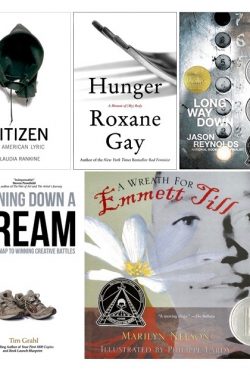
During graduate school, there were many weeks of being so overloaded by assigned reading that I couldn’t do it all and felt constantly behind. I recognized that the goal was to learn to skim and to put my hands on more and more research, even if I couldn’t savor many pieces. The trouble was that the more I couldn’t savor what I was reading, the more I associated reading itself with feelings of being overwhelmed and behind. When I shared with a mentor how stressful ... Read more ...
“Pedagogical Too-Muchness,” Or a Call for Shaking up Schooling
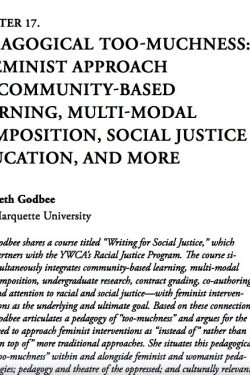
This year I turned 39, and it’s my first in which I won’t be returning to school. I’ve spent my life in academic settings—as a child and adult, as a student and teacher, as a researcher and writer. Many of my friends are teachers, too, so I understand how August brings both angst and anticipation for the upcoming school year. Recently, I’ve been having conversations with friends about syllabi and course designs. I’ve been reading social media posts about the start of ... Read more ...

