
This year I turned 39, and it’s my first in which I won’t be returning to school. I’ve spent my life in academic settings—as a child and adult, as a student and teacher, as a researcher and writer. Many of my friends are teachers, too, so I understand how August brings both angst and anticipation for the upcoming school year.
Recently, I’ve been having conversations with friends about syllabi and course designs. I’ve been reading social media posts about the start of school. And I’ve received emails from several people asking me to share my experience teaching “Writing for Social Justice.”
The combination of these conversations, posts, and emails has reminded me of the importance of rethinking what we know and have typically experienced as education. So much of schooling needs to be shaken up/off, as traditional schooling perpetuates social inequities, damaging discourses, and injustice. What we’re typically conditioned into—conditioned to accept and expect from schooling—does harm by contributing to the status quo. (I’m thinking here of scholarship by bell hooks and Paulo Freire, in Rethinking Schools and Teaching Tolerance, and in research journals like Feminist Teacher and Equity & Excellence, among many other sources.)
Given the recognized harms of schooling, August seems like the perfect time to question what we know about teaching and learning.
- How might we intervene into and rewrite the scripts of schooling?
- How might we rethink not only curriculum and content but also assignments, assessment, and activities that structure relations in and out school?
- How might we change our approaches to education, even if/when those changes are considered “too much”?
I raise these questions and share my own attempts at trying to teach differently—perhaps “too much” differently—through a newly published chapter, “Pedagogical Too-Muchness: A Feminist Approach to Community-Based Learning, Multimodal Composition, Social Justice Education, and More.”
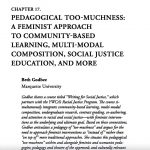

As part of the collection Composing Feminist Interventions: Activism, Engagement, Praxis edited by Kristine L. Blair and Lee Nickoson, this chapter describes my approach to “Writing for Social Justice” and situates feminist, critical education as “instead of” rather than “on top of” more traditional approaches.
Throughout the chapter, I share several guiding principles:
1. engage our full selves—not only our minds, but also our bodies, emotions, and spirits;
2. prioritize relations, or put the time and effort into building and sustaining meaningful (and often cross-status) connections among people and organizations;
3. understand power as related to (in)justice so that efforts against sexism and for gender-and-sexuality-justice are linked with other justice-oriented work, since identities and issues are intersectional and injustice anywhere is injustice everywhere;
4. cultivate agency so that students and other actors see themselves as having the responsibility to act, as well as the questions and insights to ask who is responsible to act, when, where, why, and how (troubling savior and victim narratives);
5. seek interconnectedness among ways of seeing, thinking, doing, and being in the world so that we work toward coherence across spheres of activity and recognize that our work occurs within complex socio-cultural, historical, and rhetorical systems.
(pages 337-338)
I share this chapter and these principles as part of ongoing conversations about how to do education differently—toward making commitments to justice actionable. My hope is that the more we think of social justice education as the core or center of schooling, the more we shift away from schooling that leads educators to dismiss critical approaches as additional, extra, or “too much” to take on.
Truly, we all—students and teachers alike—need courses that are complex, critical, and transformative. We need educational practices that humanize people and develop relational responsibilities. We need concerted effort to disrupt the status quo, foster commitments to justice, and build agency beyond the classroom.
Though I won’t be returning to the classroom this fall, I’ll be reading, writing, and engaging as someone with much to shake up/off about my own educational history. May we share in this ongoing work and lifelong learning. May this new school year invite new ways of approaching education and learning to take action in this time of urgency.
—
This post is written by Beth Godbee for Heart-Head-Hands.com. For more posts like this one, you might try “Triangulating the Heart, Head, and Hands for Justice,” “What Is Justice?” and others posts on teaching. Please also consider liking this blog on FB and following the blog via email. Thanks!


Leave a Reply