
Writing retreats are for writers creating across genres, at any stage, and for various audiences, including ourselves. But so often, even when we spend our lives working with words, we bracket what counts as “writing,” and we find it hard to claim the role of “writer.” This blog post combines reflections from two of us, Beth and Phoenix, about the experience of one-day, online writing retreats. Together, we want to affirm that, truly: writing is expansive, and writing retreats are for all sorts of writing.
Beth’s Reflections: Expanding What Counts as “Writing”
I am sometimes asked questions like “Can I join a writing retreat to handwrite letters?” or “What I really want is a day to pause and reflect. If I’m only journaling, would that be a problem?” or “I’ve been working on this creative project that’s more about art and illustration … would that be ‘writing’ enough for a retreat?”
My answer to these and others questions is always a resounding YES!
Though I know that schooling can teach us very restrictive definitions of writing and though I catch myself saying “real writing” sometimes (and cringing afterwards), I want to be moving with the most imaginative, interruptive, and life-giving definitions possible. Because, really: what is not writing? Especially what is not writing when we understand writing as creating, inventing, drafting, revising, rethinking, putting into words, translating, figuring out, offering out, brainstorming, clarifying, reading, re-reading, reflecting, outcrying, and so much more, including living out the identify of a “writer”?
When I designed the retreat days, I wanted to be sure there is a mix of intentional time ~ time to create, time to reflect, and time to talk with others. So, retreats allow time to write or read or sprawl out on the floor with text. They can invite us to revisit our writing practices and to recommit to the projects we’re longing to do. In the first hour, we get grounded with a guided meditation and freewriting. In the afternoon, there’s the option of a short coaching conversation, and we close with a shared writing prompt. In between, there’s time to move at our own paces, in our own ways. Hopefully, the structure offers both a supportive container and the flexibility to follow intuition.
I share these reflections to say more simply:
If you feel called toward a retreat, trust the calling.
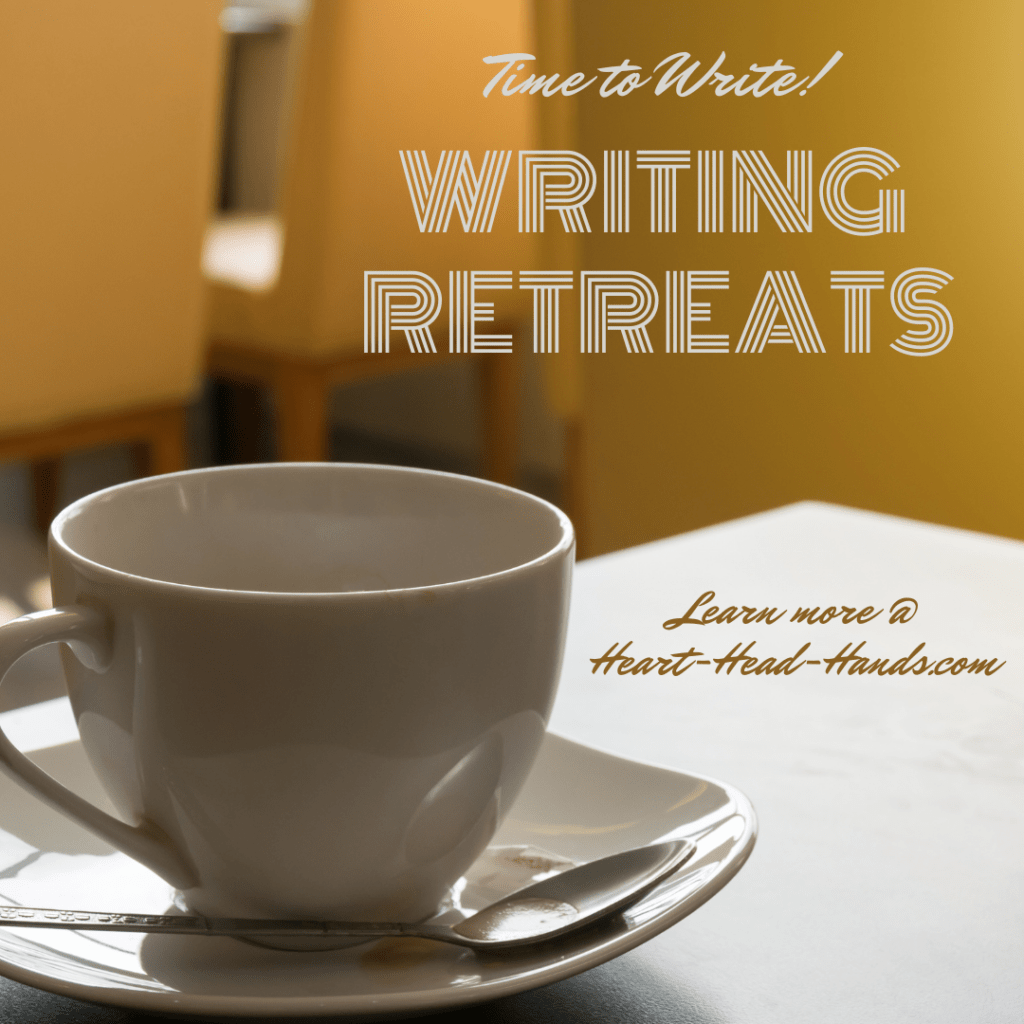
And here are a few more reasons to join a writing retreat, with reflections from Phoenix Robertson, who’s working with Heart-Head-Hands: Everyday Living for Justice as a communications assistant. Phoenix joined a retreat in July and describes the experience as follows.
Phoenix’s Reflections: Changing the Notion of “Writing” and “Writing Retreats”
Despite the fact that the writing retreat I joined in July was my first time in a retreat, I wasn’t a complete stranger to the concept. My mom, Dr. Epps-Robertson, had been attending writing retreats since 2020, so I’d heard a bit about these retreats before. Even though I’d been learning from a distance for four years, it was a completely different experience than I’d imagined.
I began my day with a cup of tea and listened to the other retreat participants state their intentions for the day. The first thing that surprised me was how other participants, other writers, were going to structure their days. Some said they were working on more formal or academic works of writing, others letters, while still others worked on household projects or wrote in journals. My preconceived notion of what it meant to attend a writing retreat meant working on “traditional” writing—writing essays, books, blog posts—things one would typically associate with writers.
I decided to spend my first portion of the retreat working on writing alt-text and doing communications work for Heart-Head-Hands. Not only can writing retreats be used for creative time, but also as a space to find accountability and work on tasks that simply need to be done. The idea of working alongside others, even on separate tasks, can create a sense of community that isn’t found in working alone.
After the morning’s work time, it was time for lunch. I spent my break time away from screens as a way to decompress from the Zoom exhaustion I was beginning to feel. It is from this mid-section of the retreat that I discovered a tip that I would extend to future writing retreat goers: don’t work through your lunch/break time! As tempting as it can be to press on when you find yourself “in the zone,” it is important to pace yourself. Taking breaks is crucial to maintaining energy and a sense of productivity.
After the break and a quick group meditation, I enjoyed the second work session by working on a collage art project that I’d been trying to find the time for. This second work time allowed me to bring out my creative self and play a bit. It was fun to spread out on the floor and spend time piecing visuals together, as I later did above for the collage (below) representing my retreat experience.
My experience in the writing retreat changed what I thought “writing time” should be used for. I came in with a very rigid, traditional idea of how writing and creative time can be spent. Creative acts, like writing, can manifest in many different ways and, when performed in community, can lead to new insights and intentions. Now I am viewing writing to be less about pure, direct communication and to include an expression of one’s own thoughts and feelings—a true demonstration of the fact that writing retreats are for all sorts of writing.

Artist’s Statement: Attending a writing retreat inspired me to express, in a non-traditional medium, the vastness of the experiences that a person can have when it comes to writing and creativity in general. I utilized clippings from magazines and comic books, as well as paint on a blank canvas to create this piece. My collage symbolizes the intersection between text-based “writing” and other forms of creative expression like gardening and visual art. I hope to demonstrate that self-expression comes in many forms and that all have value.
—
This post is written by Beth Godbee, Ph.D. and Phoenix Robertson, Communications Assistant, for Heart-Head-Hands: Everyday Living for Justice.
If you’d like to try a writing retreat, register here. There are typically five or six open dates at a time, and retreats are offered on different days to accommodate different schedules.
Registration is offered on a sliding-scale basis, reflecting commitments to accessibility and community care. If you need something not currently reflected through the registration page (e.g., a no-cost option or invoicing), reach out. We want to be sure that no one is priced out of participating.


Leave a Reply