• Skip to primary navigation
  • Skip to main content
  • Skip to primary sidebar
  • Skip to footer

Heart - Head - Hands logo

  • Home
  • About
    • Beth Godbee
    • Commitments
    • Publications
  • Blog
    • Contemplative Practices
    • Emotional Literacies
    • Everyday Feminism
    • Higher Education
    • Interviews
    • Racial Justice
    • Recipes and Why Vegan?
  • Work with Me
    • Coaching
    • Courses, Retreats, Workshops
    • Career Discernment
    • Pathways Through Burnout
    • Writing Groups
  • Subscribe
  • Contact
  • Navigation Menu: Social Icons

    • Facebook
    • Instagram
    • LinkedIn

A Minimalist Guide to Essential Oils

Filed Under: Everyday Feminism By Beth Godbee May 22, 2019 2 Comments

Recently, a friend asked what essential oils might best help with managing back pain, and I realized through answering the question that I take a minimalist (less is more) approach.

Most folks I know either invest in a wide variety of essential oils or don’t use essential oils at all. In contrast, I’ve found a few favorite oils—ones that I know reliably help me with recurring issues—and I don’t expand my collection because, well, essential oils take a lot of investment: time to research, space to store, money to purchase, and more.

Specifically, I travel with three essential oils:

  1. Tea tree, which I apply to cuts and scrapes and add to Epsom salt soaks whenever my feet need extra attention (typically, after long days hiking).
  2. Peppermint, which I rub on my belly whenever having stomach upset or GI troubles.
  3. Eucalyptus, which I use for allergies, asthma, and whenever fending off a cold.
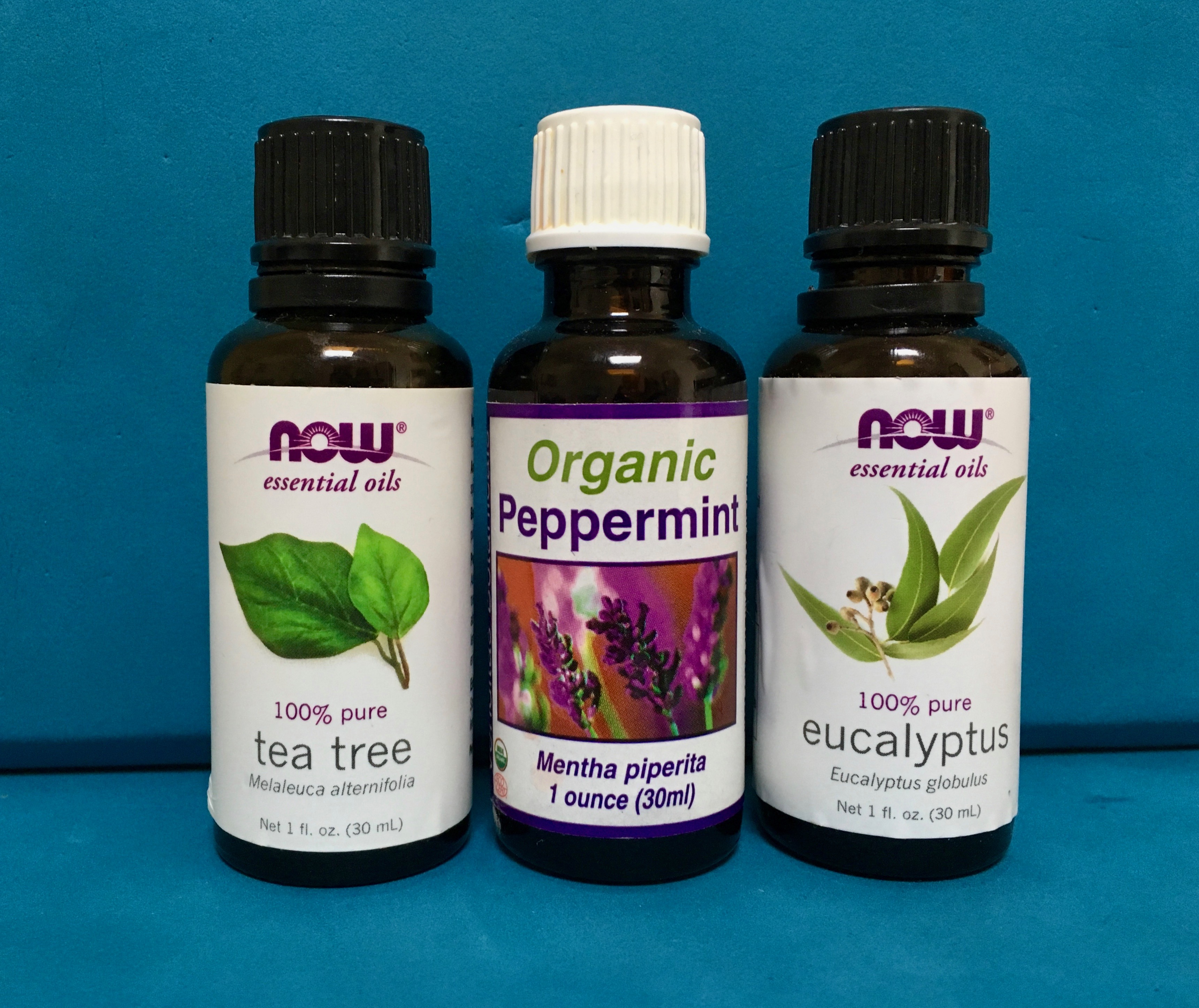
Against a blue background are 3 bottles of essential oils—from left to right: tea tree, peppermint, and eucalyptus—all the same size (1 fl. oz.).

At home, I additionally use these three:

  1. Lavender, which I buy in bulk for use in Epsom salt baths, to relieve headaches, and for sprinkling on my pillow whenever I need sleep support.
  2. Lemon, which I use whenever my digestion is off or I need some extra digestive support. I also add lemon to homemade deodorant and cleaning solutions, apply to mouth sores, and rub into swollen lymph nodes.
  3. Grapefruit, which I use like lemon as an addition to homemade deodorant and cleaning solutions. I also apply grapefruit when I need an energy or mood boost.

I appreciate essential oils for their healing properties, and I appreciate the range of information online about essential oils and their uses. Lists like this one of “10 Essential Oils Everyone Should Stock up on” suggest other oils to have on hand.

In contrast to what’s recommended in many articles online, I’ve found that having fewer oils helps me use those few more often. It may be that I can only remember so much at a given time, so limiting myself to 3 or 6 helps me remember to reach for an oil when having a new or recurring health issue.

Why Essential Oils?

Though I’ve come to essential oils through my history with back pain and through navigating systems of integrative and holistic medicine, I’ve subsequently realized their role in settling the body and calming the nervous system—actions that are crucial for responding to injustice. 

So many sources—from adrienne maree brown’s Emergent Strategy and Resmaa Menakem’s My Grandmother’s Hands (both released in 2017) to Tada Hozumi’s work on cultural somatic therapy and the organization Generative Somatics: Somatic Transformation and Social Justice (and the list could go on, centering BIPOC)—we see the central role that the body plays in healing trauma + injustice and in building possibilities toward liberation + justice.

Healing the body is part of the story, part of what’s involved in showing up day after day, for the long haul, toward justice. And essential oils can support healing—physical, emotional, mental, and spiritual healing.

Certainly, the use of essential oils isn’t essential. Still, I hope that this simple guide—a short list of essential oils to try—may help on journeys to uproot, dismantle, and transform oppression in its many forms.

—
This post is written by Beth Godbee for Heart-Head-Hands.com. For more posts like this one, you might try “Learning from and Healing Scars, Both Personal and Collective” and “Today Healing Looks Like …”

If you appreciate this site, if you connect with the storytelling, or if you use any of the recipes or resources, consider making a one-time or sustaining donation. Please also consider subscribing to posts and liking this blog on FB. Thanks!

Share this:

  • Print (Opens in new window) Print
  • Share on Facebook (Opens in new window) Facebook
  • Share on X (Opens in new window) X
  • Share on LinkedIn (Opens in new window) LinkedIn
  • Share on Pinterest (Opens in new window) Pinterest

Tagged with: community care, countering perfectionism, embodiment, environmental justice, healing, pain, racial justice, self-care, social justice, understanding injustice, vegan

Support the Work

Previous Post: « Turning 40 with the Gift of 40 Miles: Why I’m Taking Myself on Walks This Month
Next Post: What Is Career Discernment? »

Reader Interactions

Comments

  1. jennifer_alzate

    May 24, 2019 at 7:17 pm

    Love this! I get overwhelmed with all the oils out there so it’s reassuring to hear that you’ve settled into just a few that work for you.

    Reply
    • Beth Godbee

      May 24, 2019 at 9:44 pm

      Thanks for this feedback! I’m glad to hear this approach resonates with you. I keep thinking that surely I’m not alone in appreciating and wanting to remember only a few oils?

      I so appreciate you reaching out to share your experience.
      ~ Beth

      Reply

Leave a Reply Cancel reply

Your email address will not be published. Required fields are marked *

Primary Sidebar

About This Site

Embodied knowledge matters. So do commitments. And especially acting on commitments as part of everyday life, BIG and small. This website—a mix of blog posts and research writing, courses and offerings—shares ongoing efforts toward everyday living (feeling, thinking, and doing) for justice.

Subscription Options

Six subscription options are available, offering a range of support ~ from participation in writing retreats and workshops to one-with-one coaching.

This image shows six subscription options through Momence, beginning at $5+ per month. Six subscription options are available, offering a range of support ~ from participation in writing retreats and workshops to one-with-one coaching.

Featured Offerings

This e-course announcement shows a yellow sunflower and blue sky. It includes a textbox with the following information: “E-COURSE AVAILABLE NOW! Career Discernment for Academics: Aligning Career with Commitments. Self-paced study, exercises, coaching, and more ...”

This ad reads: “Time to write! Writing Retreats. Learn more @ Heart-Head-Hands.com.” A white coffee mug and table appear in the foreground, with golden chairs and walls in the background.

This image shows a nature-based writing scene (loose-leaf tea, flowers, blank page, and pen) and shares information: “Weekly writing groups. Write in community. New groups open seasonally. Multiple registration options: Heart-Head-Hands.com.”

This image shows a blazing campfire in a mountain setting at dusk. It shares workshop information: “Practices for Navigating Burnout. Interactive Small-Group Workshops. Offered by Beth Godbee, Ph.D. & Candace Epps-Robertson, Ph.D.”

This image shows a scene of wrapped packages, a pine cone, and evergreen branches. A white text box shares the circular logo for Heart-Head-Hands: Everyday Living for Justice, and another text box reads: “gift cards available.”

Categories

  • Contemplative Practices (80)
  • Emotional Literacies (108)
  • Everyday Feminism (147)
  • Higher Education (72)
  • Interviews (14)
  • Racial Justice (77)
  • Recipes and Why Vegan? (37)

Subscribe to Newsletter

Footer

Follow on Instagram

About Beth Godbee

I'm an educator and former writing studies professor who believes our fully embodied selves matter in the world. We can’t just think our way out of the incredible injustices, dehumanization, violence, and wrongdoing that characterize everyday life. We must feel and act, too. [Pronouns: she/her.] Read more ...

This image shows books alongside the words: courses, coaching, consulting. learning + unlearning.

Copyright © 2026