
I’ve been spending a lot of time recently on paths. Established hiking trails and sidewalks, escalators and even rock crawls marked by arrows.


And I’ve been especially appreciative for the healing that comes from this time walking—not only hiking, but standing, marching, experiencing the mobility associated with movement, strengthening and using my body, contemplating my embodied existence, and examining the various privileges and positionings associated with this embodiment.
While walking these varied paths, I’ve also been thinking about how much needs to change about our current world. Making change isn’t as simple as swapping out elected officials or taking part in the political process. Rather, I think we’re at a critical point of needing to re-rethink everyday and taken-for-granted ways of being. To de-routinize the routine. To let go of what’s become normalized.
Because oppression is everyday. Marginalization is routine. Violence is normalized.
Choosing Alternate Paths
Thinking about paths—and the ways that we’re conditioned to follow established ones—I’m wondering, as Sara Ahmed does, whether we might need to stop treading on familiar paths and instead create some new ones. Ahmed observes the possibility that when we abandon well-trodden paths, their lines fade:
“We can see the path as a trace of past journeys. The path is made out of footprints—traces of feet that ‘tread’ and that in ‘treading’ create a line on the ground. When people stop treading the path may disappear. And when we see the line of the path before us, we tend to walk upon it, as a path ‘clears’ the way. So we walk on the path as it is before us, but it is only before us as an effect of being walked upon … Lines are both created by being followed and are followed by being created.” (Sara Ahmed, Queer Phenomenology, p. 16)
There are important functions to paths, such as making the world easier to navigate. Yet, “going along with” the established path is the sort of “going along with” that prevents questioning, much less interruption, of the everyday route and routine. And questioning seems important to noticing, imagining, rethinking, and healing. When I walk down a different sidewalk, I certainly see different bits of the world. How might I see the world differently—and change it—just by choosing alternate paths?
Walking Backward on Moving Walkways
Paths offer a useful way to imagine resistance. Beverly Tatum describes systemic racism as the airport’s moving walkway, using the metaphor to help us see the different consequences of actively pursuing/doing harm, remaining still/complacent within an existing system, and intentionally taking action (like turning around and walking backward) to resist:
“I sometimes visualize the ongoing cycle of racism as a moving walkway at the airport. Active racist behavior is equivalent to walking fast on the conveyor belt. The person engaged in active racist behavior has identified with the ideology of White supremacy and is moving with it. Passive racist behavior is equivalent to standing still on the walkway. No overt effort is being made, but the conveyor belt moves the bystanders along to the same destination as those who are actively walking. Some of the bystanders may feel the motion of the conveyor belt, see the active racists ahead of them, and choose to turn around, unwilling to go in the same destination as the White supremacists. But unless they are walking actively in the opposite direction at a speed faster than the conveyor belt—unless they are actively antiracist—they will find themselves carried along with the others.” (Beverly Daniel Tatum, Why Are All the Black Kids Sitting Together in the Cafeteria? and Other Conversations About Race, p. 11-12)
Like following the established path, standing still on the moving walkway perpetuates systemic oppression that is already part of everyday life. Such metaphors help us think about how everyday and familiar actions—like walking—can do harm, even when the intention isn’t to harm. And this distinction between intention and outcome is important for understanding how we all do harm. Microaggressions happen many times throughout the day, often without the intention to harm, but are harmful nonetheless.
From my recent experiences hiking, I think about how trails cause erosion. When the land becomes too hurt, signs are put up asking hikers to stay off fragile areas and to use bypass routes toward helping with restoration. Like recognizing that erosion comes from simply walking on established trails, I hope to explain that harm can be done by simply “going along with” what’s familiar, what’s already established, what’s already moving forward.
-

- Erosion.
-
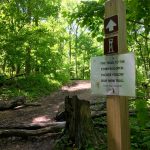
- Sign re-routing hikers onto an alternate path.
Certainly, walking off trail or turning around to walk against the moving walkway requires many kinds of strength. And I believe the emotional strength for de-routinization and de-normalization requires courage, self-love, and willingness to see one’s self doing harm. Rather than denying that my hiking causes damage to the earth, I recognize that I contribute to erosion, and I try to figure out how to hike with lower impact. Similarly, in recognizing my own contribution to systemic –isms (racism, sexism, classism, etc.), I commit to ongoing and necessary steps.
Together, may we let go of the established paths and work to build new, more equitable, more just walkways. In other words, may we choose to tread another path.
—
This post is written by Beth Godbee for Heart-Head-Hands.com. Please consider liking this blog on FB and following the blog via email. Thanks!


Leave a Reply