
I like following the blog Raising Race Conscious Children because it helps me relate with the young people in my life, including my own inner child (my younger self). Among the blog’s resources are examples of scripted conversations and sample statements that align with racial justice. Such language helps me think about the language I use with myself, including language that reinforces an old lie: “I’m not enough.”
I’ve been thinking about this message—“I’m not enough”—as a lie since a student recently shared Jim James’s song “Same Old Lie.” At the start of my “Writing for Social Justice” class, we typically listen to protest songs. Students bring into class music that they enjoy, music that shapes their understandings of justice.
When the student shared this song, I listened carefully, following along with the lyrics. Then the student asked us each to identify a “same old lie” we’ve been taught.
At first, I wrote about internalized sexism: messages that my value is tied to being thin, pretty, and white; messages that I should wear make-up and should not have body hair. I could see how these “lies” are wound up with a much bigger one: that, as a woman, I’m not enough. Constant efforts to reshape, refine, and re-create the body all indicate this not enoughness.
As I wrote about the work I’m constantly doing to unlearn sexism, I thought about a different but related set of messages I’ve inherited about class, education, and even productivity. I often try to shore up my sense of self (to shield or secure myself) through credentials, educational attainments, honors, and other markers of “success.” I fall back on degrees and measurable productivity to create a sense that I’m doing well, that I’m meeting my next goal, and that I’m worthy. In doing so, I’m unintentionally upholding the Protestant work ethic and the social stratifications it creates. These old patterns are related to my perfectionism (something that’s served me well in the past, but is now tripping me up). They are also related to the deeply internalized message that I’m not enough as I already am—that I must be striving for something more, something better.
I’ve been working with mantras to let go of this not-enoughness discourse, affirming daily:
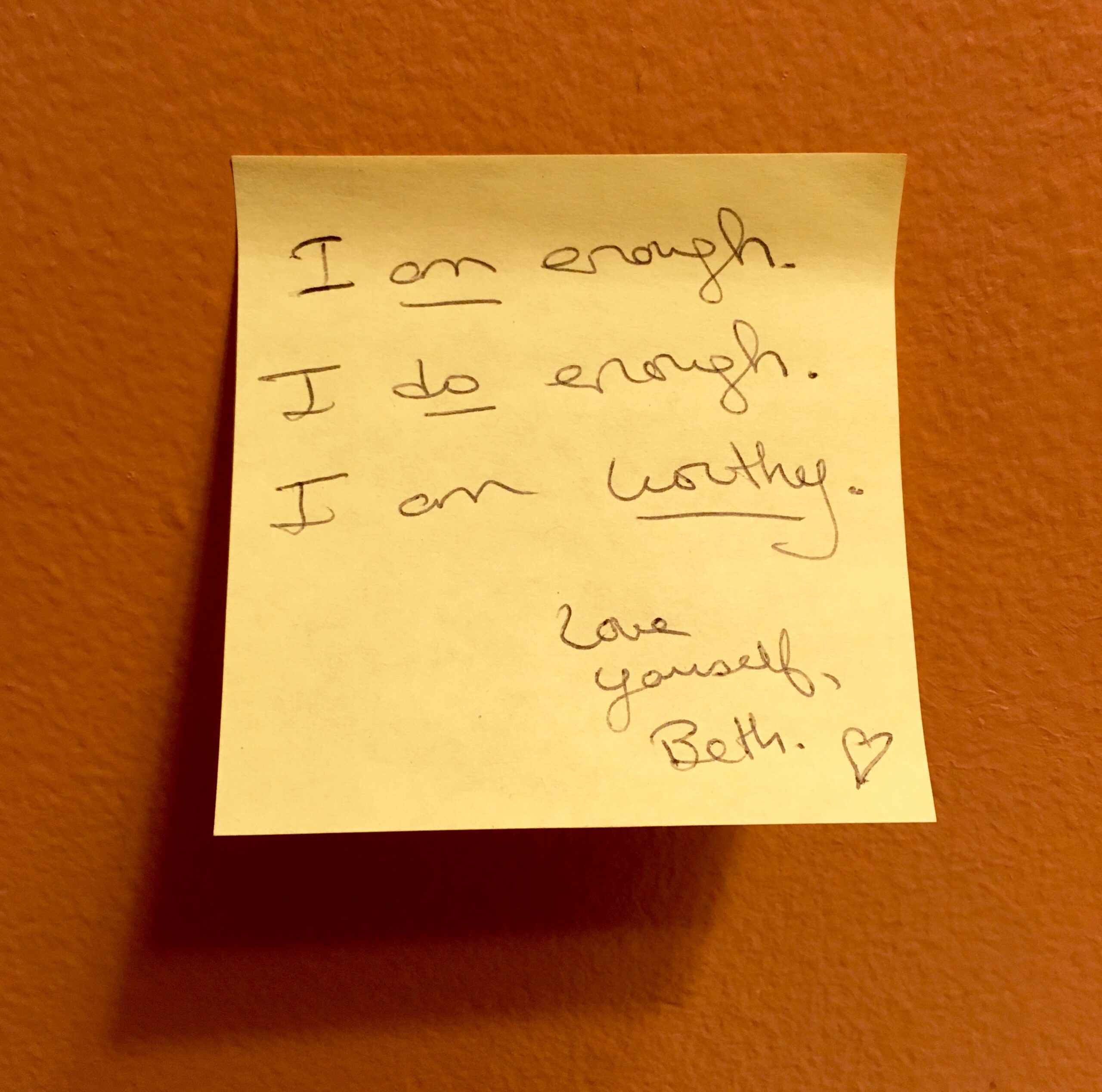
Still, I’m finding something new, something powerful in this exercise of naming “I’m not enough” as a “same old lie.”
I can see more clearly that this internalized and seemingly individual issue perpetuates and is perpetuated by larger systems of injustice—the holding down (denigrating) of some people and the holding up (elevating) of others.
I can also see more clearly the relationship between being rocked by internalized sexism (feeling that I must shield myself from awful feelings of inadequacy) and the inability to confront white supremacy and other forms of privilege (experiencing white fragility when faced with seeing one’s position as more-than-enough—that is, socially constructed as superior—within race, class, religion, ability, and various other social hierarchies).
It feels especially important to name the dualistic problem of not-enoughness facing people who experience both internalized oppression and internalized supremacy (for example— white women like myself). Imagine a single coin with two sides, one facing up and the other facing down. We can see only the side that’s exposed to us (this side representing lesser-than messages of “you’re not enough”).

What happens if we don’t ask what’s on the other side? If we don’t turn the coin over? If we only focus on the feelings of being lesser-than? Then we fail to see the still present, though hidden, side—the side in which we’re actually positioned as greater-than (in a position of privilege, power, and supremacy).
My sense is that too often we don’t flip the coin, which explains why white women can deny or fail to explore participation in white supremacy. It’s as though the fixation on the lesser-than side makes it impossible to turn the coin over. Perhaps it feels too painful to touch the coin at all?
Though we may only look at one side of the coin, the other side is still present and simply hidden from view—though perfectly visible to others who are scratching their heads, asking why folks just can’t see what’s going on. What I’m hoping to explain through this coin metaphor is that there’s a close relationship between internalized oppression and internalized supremacy.
To step back for a moment, it might help to name the warrants (or assumptions) this metaphor is built on. I’m assuming the following:
- That readers share a commitment of working to attain equity and justice.
- That though we’re socially constructed as unequal, we as humans are equal (all valuable, worthy, and human).
- That there’s a relationship between buying into internalized oppression (e.g., buying into sexism, even while feeling/experiencing its harm) and buying into the conditions of inequity (which keep us feeling/experiencing separation).
- That buying into internalized oppression is closely related to buying into internalized supremacy, so that these ideologies can co-exist within the same individual, even when trying to hold ourselves accountable through self-work.
In my life, I can see that I’ve bought into internalized sexism at the same time as using class, race, and other positions of supremacy as a shield from gendered oppression. Only when looking at feelings of not-enough straight-on can I see my own participation in perpetuating the lie. Then possibilities emerge for seeing and changing my own participation in passing along the lie to young people—to my own inner child and to children in my life.
So, there’s BIG TROUBLE in the lie that “I’m not enough.” This lie limits the ability to see systems of inequity, injustice, and violence. It limits the ability to act. It limits the potential of undoing sexism, classism, racism, and other -isms. It limits the potential of imagining alternatives—a vision of the world in which we all are already enough, already worthy, already valuable.
To stop telling the lie, I affirm today that I am enough. I speak to myself as I would to a young child, affirming my humanity. Being human is messy, sure, and I’m sure to mess up. But the mess does not make me less. I remind myself to that I am worthy. And to step into worthiness, I step into the ability to stand TALL, to speak UP, and to act with COURAGE.
—
This post is written by Beth Godbee for Heart-Head-Hands.com. Please consider liking this blog on FB and following the blog via email. Thanks!


Beth, another provocative piece. I am struck by the ties between psychology and politics, by the way we limit ourselves and in so doing limit others. Only Connect!
Thanks, Anne, and YES: very true. We live in ourselves, in our bodies, and in our everyday lives the larger politics that are too-often imagined or cast as being “out there.” I’m trying to get into the very personal nature of the structural, institutional, and culturally constructed. I’m following in a long line of feminist and womanist scholar-activists who proclaim: “The personal is political.” Glad to be connecting with you in the process. Sending love.
I love this entry. Saving and printing to reread later.
Thanks, Katie! 🙂 It’s good to know what resonates. I’m working now on a related post about “comfort” — will share soon. 🙂
Reblogged this on Kys Creative Art Pages and commented:
Sharing on my Blog. Its Very True.
Thanks for sharing this piece … I’m glad it resonates and speaks to you too! <3
Yes Very Much so 🙂