• Skip to primary navigation
  • Skip to main content
  • Skip to primary sidebar
  • Skip to footer

Heart - Head - Hands logo

  • Home
  • About
    • Beth Godbee
    • Commitments
    • Publications
  • Blog
    • Contemplative Practices
    • Emotional Literacies
    • Everyday Feminism
    • Higher Education
    • Interviews
    • Racial Justice
    • Recipes and Why Vegan?
  • Work with Me
    • Coaching
    • Courses, Retreats, Workshops
    • Career Discernment
    • Pathways Through Burnout
    • Writing Groups
  • Subscribe
  • Contact
  • Navigation Menu: Social Icons

    • Facebook
    • Instagram
    • LinkedIn

Microaggressions: Too Sanitized, Too Safe, and Too Small?

Filed Under: Everyday Feminism, Higher Education, Racial Justice By Beth Godbee March 4, 2022 Leave a Comment

I’m grateful to share a new article: “Do We Really Understand Microaggressions?” which is published online with Ms. Magazine.

This piece is co-authored with Rasha Diab and part of our ongoing research on countering microaggressions.
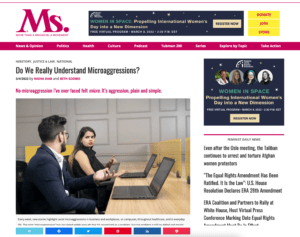
This screenshot shows the article published at Ms. Magazine with the title “Do We Really Understand Microaggressions?” 3/4/2022 by Rasha Diab and Beth Godbee and the tagline: “No microaggression I’ve ever faced felt micro. It’s aggression, plain and simple.” A photo of two people sitting side-by-side with laptops shows expressive facial expressions and hand gestures.

This screenshot shows the article published at Ms. Magazine with the title “Do We Really Understand Microaggressions?” 3/4/2022 by Rasha Diab and Beth Godbee and the tagline: “No microaggression I’ve ever faced felt micro. It’s aggression, plain and simple.” A photo of two people sitting side-by-side with laptops shows expressive facial expressions and hand gestures.

Here’s the opening:

In recent years and especially since summer 2020, in the aftermath and reckoning of George Floyd’s murder, the term “microaggression” has become commonplace. Every week, new stories highlight racial microaggressions in business and workplaces, on campuses, throughout healthcare, and in everyday life. And now parenting magazines regularly share advice for explaining the term to children and teaching ways to intervene.

But, as the term has traveled widely, it has been misunderstood, flattened, contested, co-opted and weaponized. As with other terms created to name conditions of injustice, “microaggression” has been both watered down and blamed for watering down the harms it attempts to name. We’re now at a moment when the word feels too sanitized, too safe and too small. The number of times we’ve turned to each other and exclaimed: “No microaggression I’ve ever faced felt micro. It’s aggression, plain and simple!”

Certainly, the term causes emotional turmoil, and that turmoil is indicative of deeper trouble. The term is losing its meaning. And when we lose track of the meaning, we also lose track of the purpose: to seek justice and end aggression.

We hope you’ll read the full piece, which includes a story to put the problem in context. And reach out with questions and feedback.

This grappling with the term microaggression—both its trouble and its potential—is part of what we hope to offer as scholars of language and communication. It’s also part of our commitments to strive toward justice.

Acknowledgements:

This publishing experience has offered many lessons, and we’ve had a lot of support.

We especially want to thank Candace Epps-Robertson and Carina Fernandez-Golarz Spencer for their feedback on drafts and support through the pitching, drafting, revising, waiting, publishing, and processing.

Thanks, too, to writers who have provided inspiration, insights, grounding, and stories in writing groups and writing retreats. I’m so grateful to be co-creating writing community with you. THANK YOU.

—
This post is written by
Beth Godbee, Ph.D. for Heart-Head-Hands.com. Subscribe to the newsletter for additional resources and announcements.  

For related posts, check out “Responding to Microaggressions” and “A Barrage of Microaggressions.”

Share this:

  • Print (Opens in new window) Print
  • Share on Facebook (Opens in new window) Facebook
  • Share on X (Opens in new window) X
  • Share on LinkedIn (Opens in new window) LinkedIn
  • Share on Pinterest (Opens in new window) Pinterest

Tagged with: accountability, antiracism, commitments, conversation, emotional literacies, epistemic injustice, feminism, healthcare, interaction, language, learning, microaggressions, power, practices, racial justice, resistance, resources, social justice, understanding injustice

Support the Work

Previous Post: « Commitment Statements: Questions and Answers Pointing Toward Action
Next Post: Interrupting Writer’s Block: Writing (and Pausing) Through Resistance »

Reader Interactions

Leave a Reply Cancel reply

Your email address will not be published. Required fields are marked *

Primary Sidebar

About This Site

Embodied knowledge matters. So do commitments. And especially acting on commitments as part of everyday life, BIG and small. This website—a mix of blog posts and research writing, courses and offerings—shares ongoing efforts toward everyday living (feeling, thinking, and doing) for justice.

Subscription Options

Six subscription options are available, offering a range of support ~ from participation in writing retreats and workshops to one-with-one coaching.

This image shows six subscription options through Momence, beginning at $5+ per month. Six subscription options are available, offering a range of support ~ from participation in writing retreats and workshops to one-with-one coaching.

Featured Offerings

This e-course announcement shows a yellow sunflower and blue sky. It includes a textbox with the following information: “E-COURSE AVAILABLE NOW! Career Discernment for Academics: Aligning Career with Commitments. Self-paced study, exercises, coaching, and more ...”

This ad reads: “Time to write! Writing Retreats. Learn more @ Heart-Head-Hands.com.” A white coffee mug and table appear in the foreground, with golden chairs and walls in the background.

This image shows a nature-based writing scene (loose-leaf tea, flowers, blank page, and pen) and shares information: “Weekly writing groups. Write in community. New groups open seasonally. Multiple registration options: Heart-Head-Hands.com.”

This ad for the workshop shows a thick knitted blanket and mug of hot cocoa with whipped cream and shares the title: "Cozying Up with Your Writing" and website: Heart-Head-Hands.com

This image shows a scene of wrapped packages, a pine cone, and evergreen branches. A white text box shares the circular logo for Heart-Head-Hands: Everyday Living for Justice, and another text box reads: “gift cards available.”

Categories

  • Contemplative Practices (80)
  • Emotional Literacies (108)
  • Everyday Feminism (147)
  • Higher Education (72)
  • Interviews (14)
  • Racial Justice (77)
  • Recipes and Why Vegan? (37)

Subscribe to Newsletter

Footer

Follow on Instagram

About Beth Godbee

I'm an educator and former writing studies professor who believes our fully embodied selves matter in the world. We can’t just think our way out of the incredible injustices, dehumanization, violence, and wrongdoing that characterize everyday life. We must feel and act, too. [Pronouns: she/her.] Read more ...

This image shows books alongside the words: courses, coaching, consulting. learning + unlearning.

Copyright © 2026