
This post shares a reprint of a lesson plan “Forum Theatre: Using Boal’s Theatre of the Oppressed to Build Receptive Competence” co-authored by Beth Godbee and Rasha Diab.
In 2015, Beth Berilla assembled and published the website Contemplative Practices for Anti-Oppression Education, and we were not only grateful to be part of the collection but also regularly turned to and shared contemplative practices from the collection. Unfortunately, the website is no longer active, and we want to maintain access to this lesson plan. Here we share it again, in its original form, and with deep gratitude for how much we’ve learned from Augusto Boal‘s teachings and the practice of engaging in forum theatre.
Now, as ever, we need many interventions into everyday and systemic oppression, and we need repeated practice to build receptive literacies, which include listening, reading, and witnessing. May we continue to engage contemplative practices for anti-oppression education, including Boal’s forum theatre.
With gratitude, Beth and Rasha
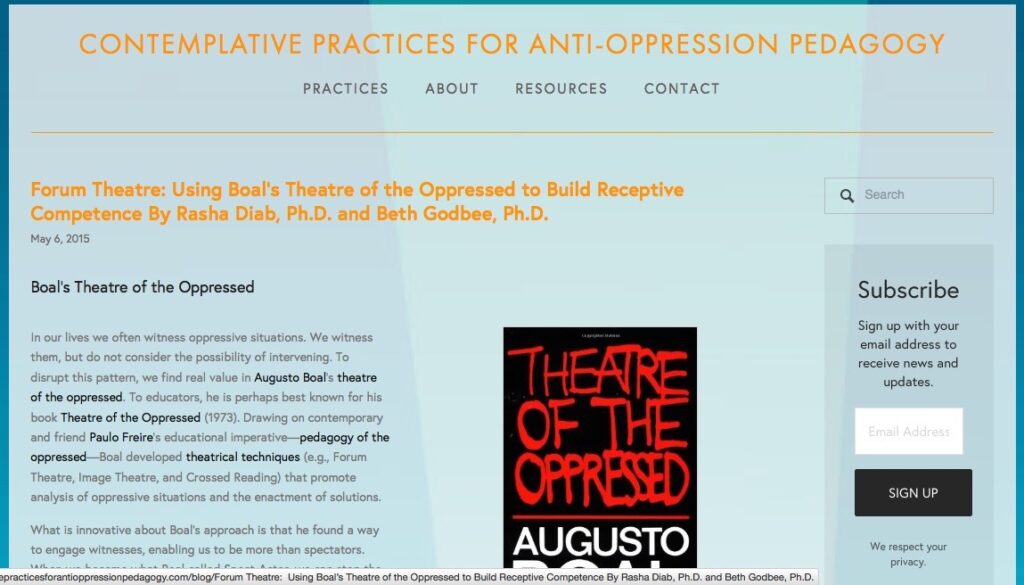
Forum Theatre: Using Boal’s Theatre of the Oppressed to Build Receptive Competence
Rasha Diab, Ph.D. | University of Texas at Austin
Beth Godbee. Ph.D. | formerly Marquette University, now Heart-Head-Hands: Everyday Living for Justice
Boal’s Theatre of the Oppressed
In our lives we often witness oppressive situations. We witness them, but do not consider the possibility of intervening. To disrupt this pattern, we find real value in Augusto Boal’s theatre of the oppressed. To educators, Boal is perhaps best known for his book Theatre of the Oppressed (1973). Drawing on contemporary and friend Paulo Freire’s educational imperative—pedagogy of the oppressed—Boal developed theatrical techniques (e.g., Forum Theatre, Image Theatre, and Crossed Reading) that promote analysis of oppressive situations and the enactment of solutions.
What is innovative about Boal’s approach is that he found a way to engage witnesses, enabling us to be more than spectators. When we become what Boal called Spect-Actor, we can stop the re-enactment of troubling scenes, step in, suggest/act an alternative way to resolve the situation, and offer an end to this case of oppression. The process of re-enacting such scenes, stopping them, and suggesting/rehearsing alternatives enables us to see the possibility of change. This process allows us to practice taking action and intervening.
Theoretical Underpinnings and Rationale
As educators invested in social justice, we are interested in how students develop the type of rhetorical listening and radical presence that Krista Ratcliffe (2004) and Mary Rose O’Reilley (1998) have written about, respectively. Both see that good and functional communication hinges on a deliberately chosen stance of reflective reception of what/how selves and others talk, be, act, and relate—the qualities of being a good listener. By involving Spect-Actors in learning to listen closely, deeply to oppression in our daily lives, we work toward dual goals: (1) developing effective communication and (2) developing effective communication for social justice.
Additionally, theatre of the oppressed invites/requires attention to receptive competence, a term used by a number of scholars in differentiating types of communicative competence (e.g., McBeth, 2001; Matsuda, 2002). Essentially, we know that schooling has over-emphasized productive competence (e.g., writing and speaking aimed at output) at the expense of receptive competence (especially listening). In this lesson plan, contemplative practices—those that foster receptive competence—are illustrated as essential and necessary for effective communication for equity and justice.
Learning Outcomes
Among other outcomes, the following are key:
- Expand communicative competence by developing receptive competence.
- Learn to see and listen to oppression in our everyday lives, to treat our own lives as sites of inquiry, and to learn from the experiences of others.
- Identify dominant attitudes, actions, and systems that perpetuate inequity.
- Rehearse intervention strategies that promote social justice in our everyday lives.
- Reflect (individually and as a group) on the range of strategies and tactics and their likely uptake/effectiveness.
Taking the Time for Practice
Forum theatre can be used in recurring class sessions over a semester or even longer in the case of programs in which staff are engaged in ongoing professional development (e.g., peer mentors, writing center tutors, or graduate teaching assistants). The longer the time together, the more in-depth attention can be given to rehearsing and unpacking intervention strategies and running through the same and multiple scenarios.
Preliminary Steps
If the context and time allows, facilitators and participants can each prepare beforehand by:
- becoming familiar with the work of Freire and Boal and their socio-historical context;
- recording one’s own performances of race, class, gender, sexuality, nationality, and other everyday-embodied positionalities; and
- developing and sharing scenarios to play out during forum theatre.
Forum Theatre
Forum theatre involves the reenactment of a troubling scenario or scene (documented beforehand) with chances to step in and change the outcome as first observed. Recorded cases can be found by searching YouTube and include this video clip that demonstrates the process:
A. Choose scenarios, and pen a script.
Ask Spect-Actors (i.e., participants) to choose a story for which it seems particularly difficult to imagine creative and productive approaches or resolutions. Take ten minutes or so to produce a skit that dramatizes the story. Generative scenarios should be:
- relevant to participants’ lives,
- specific and discrete so that moments (1) manifest oppression and (2) can be reflected on in roughly an hour,
- open to different interpretations and alternative interventions, and
- written to dramatize interaction patterns.
Sample Scenario: Nina’s literary analysis class has been pretty tense lately. Her classmates are mostly white students and a few Latino/a students. One day, during a discussion of Zora Neale Hurston’s Their Eyes Were Watching God, class discussion goes on a drastic tangent and takes a turn for the worse. Most of the class seems to agree that African Americans are always joining gangs and dealing drugs. Some students, including Nina, however, feel alienated by this turn of events but do not know how to intervene. The professor deals with the situation by putting an immediate stop to the conversation and forcing the students to stick to the text.
B. Walk through the action once.
The Spect-Actors should perform the story/skit once all the way through. Spect-Actors choose roles (e.g., as Nina, her classmates, and the professor) and then re-create the scenario as it is understood by the group. After watching and participating in the action, the group may stop to reflect or may move onto the next step, wherein Spect-Actors begin to alter the scenario, trying different interventions.
C. Alter the action.
The second time through the performance (i.e., starting over in “replay” mode), any Spect-Actor may stop the action. After calling halt, a Spect-Actor steps into a role and changes the script in any way they choose. Other Spect-Actors must adapt, enacting a different course of action. At this point, Spect-Actors playing Nina’s classmates might try different ways of disrupting the microaggressive talk; the Spect-Actor playing professor might try different pedagogical moves to engage and teach within rather than stop conversation; and so on.
D. Process what happened, and name observed intervention strategies.
After observing and participating in the altered scene, the group reflects together on what worked (and what didn’t); who was assumed to have responsibility and agency to make change (and why); and what alternate interventions might be tried. In the case of the sample scenario, the group would want to process who made interventions and who continued the conversation as scripted, as reflecting on agency, power, and privilege are essential to making change. If playing this scenario with educators, reflection could also focus on the professor’s role, available choices, and alternative actions. Often, in the course of processing, discussion also leads to the recognition of other players outside the scenario as written, so the group might also consider interventions for parents, administrators, friends/colleagues, and others potentially involved.
E. Repeat with newly altered action and with new collaborative processing.
As time allows, replay the scenario multiple times with different agents making change and trying alternatives. With each repeat, again ask “wicked questions,” or those questions the group most needs to reckon with. And continue to name and track interventions toward developing a repertoire of tactical and strategic moves.
Discussion Questions
Discussion questions, such as the following, are designed to encourage collective reflection about actions that take place during the process of performance:
- What consequences could emerge from the interventions enacted in the scene?
- What power issues were reflected in how Spect-Actors developed the scenarios and participated in the play? (Discuss how power is manifest in productions of the initial scene and in interventions explored.)
- What inequities and injustices are observed, and what work is involved in recognizing them?
- What types of interventions appear most promising for the scenario rehearsed, and why?
Assessment of Learning
In many ways, work of this kind resists the type of measurable, experimental assessment so often required by educational institutions, and yet it invites sustained meta-reflection by all parties. We recommend a two-dimensional assessment approach for both individuals and for the group.
For individuals’ self-assessment, we ask participants to engage in a process of pre-/post-reflection of their intervention communication repertoire. We have asked students to write “head, heart, hands” commitment cards, reflecting on what they are thinking (head), how they are feeling (heart), and what they will do (hands). After one or several sessions of forum theatre, students then respond to their initial cards, showing how they have listened deeply to others and used receptive competence to effect change in themselves. Participants are able to use commitment cards after the session(s) to track their own goals (i.e., what they will do with their “hands”).
For collective assessment, the whole group reflects on receptive competence in general and listening in particular and its potential for enhanced communication for social justice. Participants are encouraged to contemplate on the material consequences of different communicative choices they make and the uptake of these choices. This collective “debriefing” allows facilitators to focus attention toward the learning outcomes and follow-up sessions.
Acknowledgements
Thanks to Tanya Cochran and Manisha Pathak Shelat, who have co-led forum theatre workshops with us and have co-authored an early draft of this lesson plan.
Resources
Babbage, F. (2004). Augusto Boal. New York: Routledge.
Boal, A. (1992). Games for actors and non-actors. New York, NY: Routledge.
—. (1995). The rainbow of desire. New York: Routledge.
—. (1982). The theatre of the oppressed. New York, NY: Routledge.
—. (2006). The aesthetics of the oppressed. London: Routledge.
Cohen-Cruz, J., & Schutzman, M. (1994). Playing Boal: Theatre, therapy, activism. New York, NY: Routledge.
Freire, P. (1970). Pedagogy of the oppressed. New York, NY: Continuum.
—. (1995). Pedagogy of hope: Reliving pedagogy of the oppressed. New York, NY: Continuum.
International Theatre of the Oppressed Organisation. (n.d.). Retrieved from <https://ptoweb.org/>.
Matsuda, P. K. (2002). Alternative discourse: A synthesis. In C. Schroeder, H. Fox, & P. Bizzell (Eds.), ALT DIS: Alternative discourses and the academy (pp. 191-196). Portsmouth, NH: Boynton/Cook-Heinemann.
McBeth, M. (2001). The Queen’s English: A query into contrastive rhetoric. In C. G. Panetta (Ed.), Contrastive rhetoric revisited and redefined (pp. 105-122). Mahwah, NJ: Lawrence Erlbaum Associates.
O’Reilley, M. R. (1998). Radical presence: Teaching as contemplative practice. Portsmouth, NH: Boynton/Cook Publishers.
Ratcliffe, K. (2004). Rhetorical listening: Identification, gender, whiteness. Carbondale, IL: Southern Illinois Press.
Wortham, S. (1994). Acting out participant examples in the classroom. Philadelphia: John Benjamins.


Leave a Reply